Notes and Letters on the Natural History of Norfolk
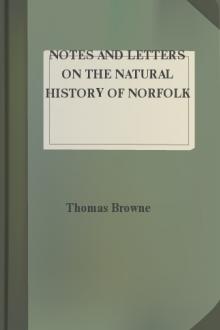
Notes and Letters on the Natural History of Norfolk
More Especially on the Birds and Fishes
 Free Download
With notes by Thomas Southwell, member of the British Ornithologists' Union; Vice-President of the Norfolk and Norwich Naturalists' Society.
Book Excerpt
eir successors, it may be fairly said that it was Browne's contemporaries and fellow-countrymen, Francis Willughby and John Ray, who laid the first solid foundation of systematic zoology in their Ornithologia and Historia Piscium, published in 1676 and 1686 respectively; but dying in 1682, Browne was indebted to neither of them, though he doubtless exercised much influence over them, and he had to use the clumsy descriptive terminology then in vogue.[C] Let me illustrate this by a single example. In one of his letters to Merrett he names a "little elegant sea plant" (probably Halecium halecinum, a species of Hydroid Zoophyte), "Fucus marinus vertebratus pisciculi spinum referens ichthyorachius, or what you think fit." On another occasion Merrett thus expresses his approval of Browne's efforts in this direction: "You have very well named the rutilus and expressed fully the cours to bee taken in the imposition of names, viz: the most obvious and most peculiar differe
FREE EBOOKS AND DEALS
(view all)













Popular books in Science, Non-fiction







More books by Sir Browne Thomas
(view all)
Readers reviews
0.0
LoginSign up
Be the first to review this book