Two Dyaloges (c. 1549)
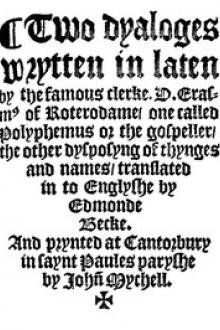
Two Dyaloges (c. 1549)
 Free Download
Book Excerpt
lour or pretêce of holynes,
that is to saye when a man prayeth not frõ the
bothum of his hart but with the lyppes only and
from the tethe outward, and that in opyn places
where great resort of people is, bycause they wold
be sene. But thy gospel boke teacheth the to praye
contynually, but so that thy prayer come from the
bothu of the hart. Poli. Yea but yet for all my
sayenge I praye sumtyme. Can. When I beseche the
when ye art a slepe? Poli. When it cometh in to
my mynde, ones ||or twyse may chaunce in a weke.
Can. what prayer sayst thou? Poliphe. The lordes
prayer, the Pater noster. Canni. Howe many tymes
ouer? Poli. Onis, & I trowe it is often inoughe,
for the gospell forbyddeth often repetynge of
one thynge. Canni. Can ye saye your pater noster
through to an ende & haue youre mynde runnynge
vpon nothynge elles in all that whyle? Poli.
By my trouthe and ye wyll beleue me I neuer yet
assayed nor proued whether I coulde do it or no.
But is it not sufficient to
FREE EBOOKS AND DEALS
(view all)








Popular books in Classic, Fiction and Literature


More books by Desiderius Erasmus
(view all)
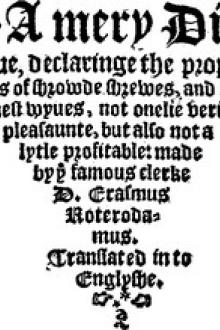
A Merry Dialogue Declaringe the Properties of Shrowde Shrews and Honest Wives
by Desiderius Erasmus
Download
Read more
Readers reviews
3.5
LoginSign up

As the other reviewer said, the English of the translation is archaic, but I found puzzling it out rewarding. There is some real wit in the writing.
The first dialogue, between Cannius and the cyclops Poliphemus begins when Cannius can't believe the cyclops is carrying a New Testament. The conversation turns to how to tell a good Christian. By clothing? By church service? by actions?
The second dialogue, between Beatus (blessed--a rich man) and Bonifacius (a handsome man--bonny-face) concerns whether it's better to have a good name or the "talents" the name implies. It ranges widely over prejudice and hypocrisy, status and pretence.
The dialogues have observations worthy of Oscar Wilde, as well as puns, but it is hard to make out sometimes, as J is used as I, Y is used as I, I is used as J, and U is used as U and V.
They are a couple of lighthearted satires, nowhere near as serious as his Against War.
The first dialogue, between Cannius and the cyclops Poliphemus begins when Cannius can't believe the cyclops is carrying a New Testament. The conversation turns to how to tell a good Christian. By clothing? By church service? by actions?
The second dialogue, between Beatus (blessed--a rich man) and Bonifacius (a handsome man--bonny-face) concerns whether it's better to have a good name or the "talents" the name implies. It ranges widely over prejudice and hypocrisy, status and pretence.
The dialogues have observations worthy of Oscar Wilde, as well as puns, but it is hard to make out sometimes, as J is used as I, Y is used as I, I is used as J, and U is used as U and V.
They are a couple of lighthearted satires, nowhere near as serious as his Against War.
- Upvote (0)
- Downvote (0)
The philosopher, priest and Dutch renaissance humanist Desiderius Erasmus of Rotterdam lived from 1466(?) till 1536. This 1549 English edition is almost impossible to read: to be able to read this volume you will need to be able to read Early Modern English. The printed edition of this booklet has 32 pages, the Kindle edition has 374 locations. For someone who can read this kind of English this book might be worth more than the 2 stars I give it.
As a sample I copy a few lines from the beginning (location 36)of this book so you can see for yourself if you'll be able to read it.
[...]
Cannius. what hunt Polipheme for here? Poliphemus.
Aske ye what I hunt for here, and yet ye se me
haue neyther dogges, dart, Jauelyn, nor huntyng
staffe. Cannius. Paraduenture ye hunt after some
praty nymphe of the couert. Poliphemus. By my
trouth and well coniectured, be holde what a
goodly pursenet, or a hay I haue here in my hande.
Cannius. Benedicite, what a straunge syght is
this, me thinke I se Bachus in a lyons skin,
Poliphemus with a boke in his hande. This is a
dogge in a doblet, a sowe with a sadle, of all
that euer I se it is a non decet.
[...]
As a sample I copy a few lines from the beginning (location 36)of this book so you can see for yourself if you'll be able to read it.
[...]
Cannius. what hunt Polipheme for here? Poliphemus.
Aske ye what I hunt for here, and yet ye se me
haue neyther dogges, dart, Jauelyn, nor huntyng
staffe. Cannius. Paraduenture ye hunt after some
praty nymphe of the couert. Poliphemus. By my
trouth and well coniectured, be holde what a
goodly pursenet, or a hay I haue here in my hande.
Cannius. Benedicite, what a straunge syght is
this, me thinke I se Bachus in a lyons skin,
Poliphemus with a boke in his hande. This is a
dogge in a doblet, a sowe with a sadle, of all
that euer I se it is a non decet.
[...]
07/19/2012