Money Magic
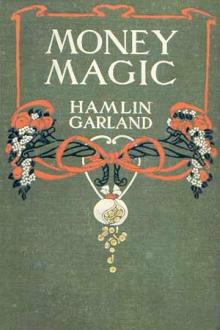
Money Magic
A Novel
 Free Download
While Mr. Garland can hardly be said to break new ground in his latest novel, he certainly sounds in it a new note. As ever, he holds the balance between East and West, between a form of daily existence, a code of social and moral ethics and practice that in its uncompromising, simple directness and frankness, its conviction of equality, its unhesitating acceptance of the principle that "a man's a man for all that" remains fundamentally American, and a society that is becoming more and more sophisticated and Europeanised. The American scene of Hamlin Garland is the Antithesis of Mrs. Wharton's.
Book Excerpt
his intentions.
"But--but--you're so old--I mean so much older--"
"I know I am, and I'm rough. I don't deny that. I'm forty, but then I'm what they call well preserved," he smiled, winningly, "and I'll soon have an income of wan hundred thousand dollars a year."
This turned the current of her emotion--she gasped. "One hundred thousand dollars!"
He held up a warning hand. "Sh! now that's between us. There are those younger than I, 'tis true, but there is a kind of saving grace in money. I can take you all out of this daily tile like winkin'--all you need to do is to say the wan word and we'll have a house in Colorado Springs or Denver--or even in New York. For what did you think I left me business on the busiest day of every week? It was to see your sweet daughter, and I came this time to ask her to go back with me."
"What did she say?"
"She has not said. We had no time to talk. What I propose now is that we take a drive out to the ranch and talk it over. Williams will
FREE EBOOKS AND DEALS
(view all)



Popular books in Fiction and Literature, Romance, Western
More books by Hamlin Garland
(view all)
Readers reviews
3.0
LoginSign up

Young, unschooled and poor, Bertha is tempted by the marriage proposal of Mart Haney, a rough and much older but wealthy gambler, particularly when the desperately lovesick man says he'll sell his saloon and lay at her feet his substantial income as a mine owner. Her decision is made for her when he is wounded and begs to marry her on his deathbed so he can endow her with his fortune. But thanks to her, he survives, though as an invalid. Now Bertha is enormously wealthy, learning and maturing thanks to her husband's generosity, but tied to a husk of a man who begins to revolt her as much as he adores her. Of course, there is an attractive young man in the picture, too.Well-drawn characters and scenic description provide the interest in this well-written novel, but the plot's sad and unsatisfying. It doesn't end quite as you'd expect, but all the same, it's a downer.
- Upvote (0)
- Downvote (0)