The Moon and Sixpence
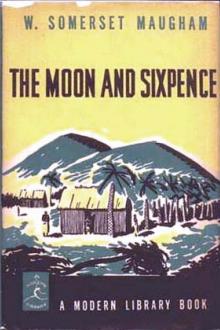
The Moon and Sixpence
 Free Download
Loosely based on the life of the painter Paul Gauguin, the story is told as a series of glimpses into the life of Charles Strickland, a middle-aged English stock broker who abandons his wife and children in order to pursue painting in Tahiti.
Book Excerpt
before. Mr. Crabbe was as dead as mutton, but Mr. Crabbe continued to write moral stories in rhymed couplets. I have read desultorily the writings of the younger generation. It may be that among them a more fervid Keats, a more ethereal Shelley, has already published numbers the world will willingly remember. I cannot tell. I admire their polish -- their youth is already so accomplished that it seems absurd to speak of promise -- I marvel at the felicity of their style; but with all their copiousness (their vocabulary suggests that they fingered Roget's Thesaurus in their cradles) they say nothing to me: to my mind they know too much and feel too obviously; I cannot stomach the heartiness with which they slap me on the back or the emotion with which they hurl themselves on my bosom; their passion seems to me a little anaemic and their dreams a trifle dull. I do not like them. I am on the shelf. I will continue to write moral stories in rhymed couplets. But I should be thrice a fool if I did it for a
FREE EBOOKS AND DEALS
(view all)




Popular books in Fiction and Literature, Gay/Lesbian

More books by W. Somerset Maugham
(view all)
Readers reviews
4.3
LoginSign up

well done
- Upvote (0)
- Downvote (0)
As the notes above mention, Maugham derived much of "The Moon and Sixpence" from the life of Paul Gauguin. And although Charles Strickland (Gauguin's proxy in the novel) is at the center, he is in fact not the main character. Let me explain.
First, Maugham formed his novel around several different characters. None of these are Strickland himself.
First is Strickland's wife -- and indeed when the narrator first meets her, Strickland himself is a non-entity. And when he throws it all away to become a painter, it is a total surprise (or would be, if one didn't know what was coming from elsewhere). Later the novel shifts to follow Dirk Stroeve, friend of the narrator and acquaintance of Strickland. Finally Maugham turns to the narrator's discussions with people who knew Strickland after he had gone to the South Seas.
So Strickland's presence is actually quite minimal. But in the end I think that is not surprising. Because he is not the real main character.
The real main character is art. That is where the action is, and that is -- I think -- why Maugham wrote "about" Strickland/Gauguin, made the painter a thoroughly unpleasant character, and then made him a creator of wonderful beauty.
The point is, in the end, how art and beauty supersede the individual, and come to mean something completely beyond him or her. This may sound like wannabe nonsense. But Maugham develops and explores the theme without a hint of pretense or condescension.
Since this is Maugham, it goes almost without saying that the writing is excellent, and the characters themselves memorable and well-drawn.
Totally recommended. Even -- maybe especially -- for people skeptical about modern art.
First, Maugham formed his novel around several different characters. None of these are Strickland himself.
First is Strickland's wife -- and indeed when the narrator first meets her, Strickland himself is a non-entity. And when he throws it all away to become a painter, it is a total surprise (or would be, if one didn't know what was coming from elsewhere). Later the novel shifts to follow Dirk Stroeve, friend of the narrator and acquaintance of Strickland. Finally Maugham turns to the narrator's discussions with people who knew Strickland after he had gone to the South Seas.
So Strickland's presence is actually quite minimal. But in the end I think that is not surprising. Because he is not the real main character.
The real main character is art. That is where the action is, and that is -- I think -- why Maugham wrote "about" Strickland/Gauguin, made the painter a thoroughly unpleasant character, and then made him a creator of wonderful beauty.
The point is, in the end, how art and beauty supersede the individual, and come to mean something completely beyond him or her. This may sound like wannabe nonsense. But Maugham develops and explores the theme without a hint of pretense or condescension.
Since this is Maugham, it goes almost without saying that the writing is excellent, and the characters themselves memorable and well-drawn.
Totally recommended. Even -- maybe especially -- for people skeptical about modern art.
07/28/2008
This is an excellent book on genius.
03/10/2006