In Search of the Castaways
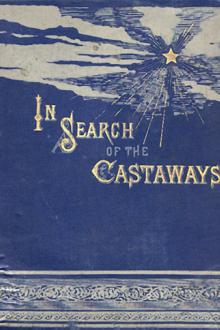
In Search of the Castaways
 Free Download
The book tells the story of the quest for Captain Grant of the Britannia. After finding a bottle cast into the ocean by the captain himself after the Britannia is shipwrecked, Lord and Lady Glenarvan of Scotland contact Mary and Robert, the young daughter and son of Captain Grant, through an announcement in a newspaper. Moved by the children's condition, Lord and Lady Glenarvan decide to launch a rescue expedition. The main difficulty is that the coordinates of the wreckage are mostly erased, and only the latitude (37 degrees) is known; thus, the expedition would have to circum-navigate the 37th parallel. Remaining clues consist of a few words in three languages. They are re-interpreted several times throughout the novel to make various destinations seem likely. (Summary from Wikipedia)
Book Excerpt
rs, the sailors threw a strong rope over the starboard side of the yacht, with a big hook at the end of it, concealed in a thick lump of bacon. The bait took at once, though the shark was full fifty yards distant. He began to make rapidly for the yacht, beating the waves violently with his fins, and keeping his tail in a perfectly straight line. As he got nearer, his great projecting eyes could be seen inflamed with greed, and his gaping jaws with their quadruple row of teeth. His head was large, and shaped like a double hammer at the end of a handle. John Mangles was right. This was evidently a balance-fish-- the most voracious of all the SQUALIDAE species.
The passengers and sailors on the yacht were watching all the animal's movements with the liveliest interest. He soon came within reach of the bait, turned over on his back to make a good dart at it, and in a second bacon and contents had disappeared. He had hooked himself now, as the tremendous jerk he gave the cable proved, and the sailors began
FREE EBOOKS AND DEALS
(view all)













Popular books in Adventure, Fiction and Literature, Nautical



More books by Jules Verne
(view all)





Readers reviews
5.0
LoginSign up

(1867) Adventure (Sea / Land Quest)
R: * * * * *
Plot bullets
Three versions of the same message , each written in a different language, is found in a bottle. It is a plea for help from Captain Grant and two sailors who have been castaway after the wreck of their ship, The Britannia.
Time and water have taken their toll on the messages, and only a sentence, here and there, can be deciphered from the total of the three.
It is the piecing together of this scattered information, with leads Lord and Lady Glenarvan, Captain Grants daughter and son, geographer Jacques Paganel (an unexpected passenger, who saves the day as often as he puts it in jeopardy), and the crew of The Duncan, on an around the world sea and land voyage to find the castaways
The certain information,, that Captain Grant and two sailors from the ship Britannia are stranded somewhere on the 37th degree of latitude is not much, with which to work. That latitude includes several islands, Patagonia in South America, Australia and New Zealand. The uncertain information, leads to several misinterpretations of the messages and prolongs the search.
The dangers of sailing the seas and treks across three land masses , become the least of their worries. On the western coast of Australia, they find a man named Ayrton, who says he was on The Britannia, and offers to help. Unknown to the searchers, he is the notorious leader of a gang of escaped criminals, and wants The Duncan to begin privateering.
Ayrton's treachery is found out and his punishment, at the conclusion of the story, is revisited in part two of Vern's three part story, 'The Mysterious Island'.
The Glenarvan's and their ship 'The Duncan' again appear in part three of Vern's story 'The Mysterious Island'.
Adventure and danger await the children of Captain Grant and those that go 'In Search of The Castaways'
Republished in 1876 as 'A Voyage Around the World'.
There is a 1962 Walt Disney movie version.
Suggested reading order for the following Verne stories:
In search of the Castaways, '20,000 Leagues Under the Sea' and The Mysterious Island.
The stories can be read independently as the author provides a synopsis of previous events necessary to the understanding of each story.
Themes begun in 'In Search of the Castaways' and '20,000 Leagues Under the Sea' culminates in 'The Mysterious Island', after introducing an initial theme to stitch all three stories together..
R: * * * * *
Plot bullets
Three versions of the same message , each written in a different language, is found in a bottle. It is a plea for help from Captain Grant and two sailors who have been castaway after the wreck of their ship, The Britannia.
Time and water have taken their toll on the messages, and only a sentence, here and there, can be deciphered from the total of the three.
It is the piecing together of this scattered information, with leads Lord and Lady Glenarvan, Captain Grants daughter and son, geographer Jacques Paganel (an unexpected passenger, who saves the day as often as he puts it in jeopardy), and the crew of The Duncan, on an around the world sea and land voyage to find the castaways
The certain information,, that Captain Grant and two sailors from the ship Britannia are stranded somewhere on the 37th degree of latitude is not much, with which to work. That latitude includes several islands, Patagonia in South America, Australia and New Zealand. The uncertain information, leads to several misinterpretations of the messages and prolongs the search.
The dangers of sailing the seas and treks across three land masses , become the least of their worries. On the western coast of Australia, they find a man named Ayrton, who says he was on The Britannia, and offers to help. Unknown to the searchers, he is the notorious leader of a gang of escaped criminals, and wants The Duncan to begin privateering.
Ayrton's treachery is found out and his punishment, at the conclusion of the story, is revisited in part two of Vern's three part story, 'The Mysterious Island'.
The Glenarvan's and their ship 'The Duncan' again appear in part three of Vern's story 'The Mysterious Island'.
Adventure and danger await the children of Captain Grant and those that go 'In Search of The Castaways'
Republished in 1876 as 'A Voyage Around the World'.
There is a 1962 Walt Disney movie version.
Suggested reading order for the following Verne stories:
In search of the Castaways, '20,000 Leagues Under the Sea' and The Mysterious Island.
The stories can be read independently as the author provides a synopsis of previous events necessary to the understanding of each story.
Themes begun in 'In Search of the Castaways' and '20,000 Leagues Under the Sea' culminates in 'The Mysterious Island', after introducing an initial theme to stitch all three stories together..
- Upvote (0)
- Downvote (0)