How to Write Clearly
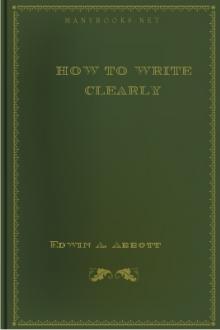
How to Write Clearly
Rules and Exercises on English Composition
 Free Download
Almost every English boy can be taught to write clearly, so far at least as clearness depends upon the arrangement of words. Force, elegance, and variety of style are more difficult to teach, and far more difficult to learn; but clear writing can be reduced to rules. To teach the art of writing clearly is the main object of these Rules and Exercises.
Book Excerpt
he Relative.
50. A statement may sometimes be briefly implied instead of being expressed at length.
51. Conjunctions may be omitted. Adverbs, e.g. "very," "so." Exaggerated epithets, e.g. "incalculable," "unprecedented."
51 a. The imperative may be used for "if &c."
52. Apposition may be used, so as to convert two sentences into one.
53. Condensation may be effected by not repeating (1) the common Subject of several Verbs; (2) the common Object of several Verbs or Prepositions.
54. Tautology. Repeating what may be implied.
55. Parenthesis maybe used with advantage to brevity. See 26.
56. Brevity often clashes with clearness. Let clearness be the first consideration.
CLEARNESS AND FORCE.
Numbers in brackets refer to the Rules.
WORDS.
*1. Use words in their proper sense.*
Write, not "His apparent guilt justified his friends in disowning him," but "his evident
FREE EBOOKS AND DEALS
(view all)










Popular books in Instructional, Language, Fiction and Literature

More books by Edwin A. Abbott
(view all)
Readers reviews
5.0
LoginSign up

very much interesting
- Upvote (0)
- Downvote (0)