The Green Odyssey
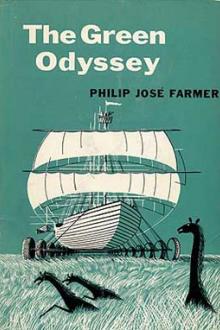
The Green Odyssey
 Free Download
Book Excerpt
livery: the scarlet and white tricorn hat and the white sleeveless shirt with the Duke's heraldic arms on its chest-- red and green concentric circles pierced by a black arrow.
The street led always downward, for the city had been built on the foothills of the mountains. It wandered here and there and gave Green plenty of time to think.
The trouble was, he thought, that if the two imprisoned men at Estorya were to die before he got to them he'd still be lost. He had no idea of how to pilot or navigate a spaceship. He'd been a passenger on a freighter when it had unaccountably blown up, and he'd been forced to leave the dying vessel in one of those automatic castaway emergency shells. The capsule had got him down to the surface of this planet and was, as far as he knew, still up in the hills where he'd left it. After wandering for a week and almost starving to death he'd been picked up by some peasants. They had turned him in to the soldiers of a nearby garrison, thinking he must be a runaway slave on
FREE EBOOKS AND DEALS
(view all)







Popular books in Adventure, Fiction and Literature, Post-1930, Science Fiction


More books by Philip José Farmer
(view all)

Readers reviews
3.7
LoginSign up

This title seems to have been withdrawn; it\'s no longer listed at Project Gutenberg. The audiobook is still listed and downloadable.I had this but lost it somehow and now can\'t find it anywherel
- Upvote (0)
- Downvote (0)
A very light, quirky and uneven adventure story: Earthman Alan Green is shipwrecked and enslaved on an unknown barbarian planet, where he is forced to minister to the whims of two very demanding women. He is without hope until he hears of "two men who have fallen from the sky in a great ship of iron" in another country and resolves to escape and join them.
Green is an odd sort of antihero, not exactly likeable, and ranging from hapless to ingenious. I agree with the previous reviewer that the ending is a letdown. Still, the tale mostly moves along, Farmer has a fun-to-read style, and his world is extremely interesting.
Green is an odd sort of antihero, not exactly likeable, and ranging from hapless to ingenious. I agree with the previous reviewer that the ending is a letdown. Still, the tale mostly moves along, Farmer has a fun-to-read style, and his world is extremely interesting.
07/27/2010
Well written, but ultimately anticlimactic story. I enjoyed several scenes in this tale and was hoping for an ending to make the uninteresting parts worth trudging through, but was sadly dissapointed. Would not recommend.
04/22/2009
Fine adventure storytelling by a master.
04/04/2007
A well structured and imaginative book.
Alan Green is an astronaut trapped on a planet where superstition holds the masses. Two years after crashing on the unknown planet he hears a rumour of other astronauts and sees an opportunity to escape.
However, superstition has demonised science on the planet. The travellers from space are condemned as demons and Green has to keep his own history and his plans secret from those around him. The story chronicles his journey to the distant city where his hopes of escape lie. Within that is the constant clash of the people around him and an imaginitive menagerie of cultures.
Well worth reading.
Alan Green is an astronaut trapped on a planet where superstition holds the masses. Two years after crashing on the unknown planet he hears a rumour of other astronauts and sees an opportunity to escape.
However, superstition has demonised science on the planet. The travellers from space are condemned as demons and Green has to keep his own history and his plans secret from those around him. The story chronicles his journey to the distant city where his hopes of escape lie. Within that is the constant clash of the people around him and an imaginitive menagerie of cultures.
Well worth reading.
03/17/2006
ANYTHING by Philip Jose Farmer is good, his approach to the Mystical is opposite to Clarke, he does not seek to rationalise in a dogmatic way, but rather lays out his wares for all to judge and appraise, and as the Victorians use to say "It's a Rattleing good Yarn"
11/10/2005