The Wailing Asteroid
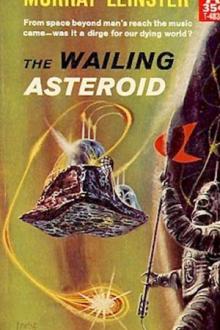
The Wailing Asteroid
 Free Download
Copyright un-renewed.
Book Excerpt
se to you. Instead, I'm going to take you back to the office. I'm going to play you a recording I made a year ago. I think that when you've heard it you'll decide you wouldn't want to marry me anyhow."
Sandy looked at him with astonished eyes.
"You mean those signals from somewhere mean something special to you?"
"Very special," said Burke. "They raise the question of whether I've been crazy, and am suddenly sane, or whether I've been sane up to now, and have suddenly gone crazy."
The radio switched back to dance music. Burke cut it off. He started the car's motor. He backed, swung around, and headed for the office and construction shed of Burke Development, Inc.
Elsewhere, the profoundest minds of the planet gingerly examined the appalling fact that signals came to Earth from a place where men could not be. A message came from something which was not human. It was a suggestion to make cold chills run up and down any educated spine. But Burke drove tensely, and the road's su
FREE EBOOKS AND DEALS
(view all)











Popular books in Science Fiction, Post-1930, Fiction and Literature



More books by Murray Leinster
(view all)
Readers reviews
3.9
LoginSign up

I agree with a previous review - the gender stereotyping is so over-the-top that the author probably intended it as a parody. However, this is a pretty good story of first contact.
- Upvote (0)
- Downvote (1)
I found the writing style a little bit clumsy, and the wrap-up a bit hasty, but a generally enjoyable story otherwise.
07/27/2009
The first two chapters seemed to get off to a slow start, and I almost gave up on the book. I'm glad I didn't, because the rest of the book was riviting.
The science is wrong, of course, but so what. The book is Science FICTION! It tells an improbably tale of adventure and excitement as could only be done in the glory days of SF.
The author as an excellant grasp, by the way, on the nature of Man and on politics in general, and these are skillfully weaved throughout the story, producing some humorous moments here and there.
Treat yourself to this book. It's free.
The science is wrong, of course, but so what. The book is Science FICTION! It tells an improbably tale of adventure and excitement as could only be done in the glory days of SF.
The author as an excellant grasp, by the way, on the nature of Man and on politics in general, and these are skillfully weaved throughout the story, producing some humorous moments here and there.
Treat yourself to this book. It's free.
07/04/2009
A generally interesting book about radio contact with aliens. It includes an interplanetary trip based on information from the aliens.
Much of the science is wrong, but that is understandable in a book this old. In particular the part about spacecraft trajectories shows a lack of knowledge of orbital mechanics. But most people wouldn't notice.
Overall, a good light-hearted space adventure.
Much of the science is wrong, but that is understandable in a book this old. In particular the part about spacecraft trajectories shows a lack of knowledge of orbital mechanics. But most people wouldn't notice.
Overall, a good light-hearted space adventure.
08/15/2008
Note to John Johnson: the movie adaptation - a British production called "The Terrornauts -- does have one thing to recommend it. The script was written by John Brunner. I didn't mind John's changes, such as making the protagonist a radio-astronomer who picked up the signals.
And there were a few loveley bits, like the scene early on where the hero, his assistant, and their girlfriends are in his office discussing the significance of the signals, when the charwoman arrives with tea: "Oh, hello, Mrs. Jones! We were just discussing the possibility of life on other planets." "Life on other planets? Cor! I don't believe it! It woulda been in the newspapers! Me 'usband woulda *told* me!" :-)
The book *is* a period piece, that takes a bit of suspension of disbelief, but it's a fun read if you don't expect brilliance.
And there were a few loveley bits, like the scene early on where the hero, his assistant, and their girlfriends are in his office discussing the significance of the signals, when the charwoman arrives with tea: "Oh, hello, Mrs. Jones! We were just discussing the possibility of life on other planets." "Life on other planets? Cor! I don't believe it! It woulda been in the newspapers! Me 'usband woulda *told* me!" :-)
The book *is* a period piece, that takes a bit of suspension of disbelief, but it's a fun read if you don't expect brilliance.
06/27/2008
I first read this book when I was in junior high school in 1960. It totally floored me and I wondered why NASA was having so much trouble getting into space.
If you ever get a chance to see the movie take my word for it an give it a pass. When I saw the movie they made in the late 1960's, early 1970's the only thing I recognized was the hero/main character had the memory of the sounds. The movie is complete garbage.
I highly recommend the book and if you have teen age children then let them read it. I think the kids will really enjoy it as I did at that age.
If you ever get a chance to see the movie take my word for it an give it a pass. When I saw the movie they made in the late 1960's, early 1970's the only thing I recognized was the hero/main character had the memory of the sounds. The movie is complete garbage.
I highly recommend the book and if you have teen age children then let them read it. I think the kids will really enjoy it as I did at that age.
12/02/2007
A highly readable, if somewhat flawed, story.
A significant part of the art of the Science Fiction author is to somehow tell an incredible tale in a credible manner. For the most part Leinster achieves this awkward balance, but on occassions one has to suspend disbelief and allow blatant absurdities pass.
Joe Burke is a man haunted by a repeating dream of an alien world. When otherworldly signals are detected from space, he finds a connection with his dream. Convinced that getting to the bottom of these signals is his destiny, and that there are messages in the dream he begins to plan an unlikely attempt to reach the source, now recognised as an asteroid in the belt between Mars and Jupiter. With the help of technological insights from the dream he builds a space ship capable of traversing the distance with minimal need for fuel and along with his companions investigates the mysteries of the asteroid.
The first half feels somewhat like 2001:A Space Odyssey. Perhaps a few too many loose ends were tied up by the conclusion, but there still remained a significant amount of mystery regarding the civilisation that left the technological legacy in the asteroid belt.
The style is at times terribly chauvinistic. In fact, it could almost be self conscious parody of a patronising attitude towards women. However I find it more likely that it was simply a reflection of the prevelant attitude of the day. Nonetheless, it was a significant detraction from the story.
A significant part of the art of the Science Fiction author is to somehow tell an incredible tale in a credible manner. For the most part Leinster achieves this awkward balance, but on occassions one has to suspend disbelief and allow blatant absurdities pass.
Joe Burke is a man haunted by a repeating dream of an alien world. When otherworldly signals are detected from space, he finds a connection with his dream. Convinced that getting to the bottom of these signals is his destiny, and that there are messages in the dream he begins to plan an unlikely attempt to reach the source, now recognised as an asteroid in the belt between Mars and Jupiter. With the help of technological insights from the dream he builds a space ship capable of traversing the distance with minimal need for fuel and along with his companions investigates the mysteries of the asteroid.
The first half feels somewhat like 2001:A Space Odyssey. Perhaps a few too many loose ends were tied up by the conclusion, but there still remained a significant amount of mystery regarding the civilisation that left the technological legacy in the asteroid belt.
The style is at times terribly chauvinistic. In fact, it could almost be self conscious parody of a patronising attitude towards women. However I find it more likely that it was simply a reflection of the prevelant attitude of the day. Nonetheless, it was a significant detraction from the story.
03/16/2006