Where the Blue Begins
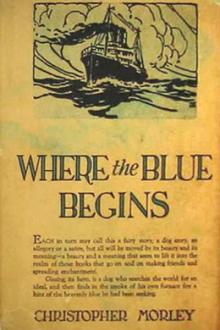
Where the Blue Begins
 Free Download
Each in turn may call this a fairy story, a dog story, an allegory or a satire, but all will be moved by the beauty and the meaning--a beauty and a meaning that seems to live within the realm of those books that go on and on making friends and spreading enchantment.Gissing, its hero, is a dog who searches the world for an ideal, and then finds in the smoke of his own furnace fire a hint of the heavenly blue that he had been seeking.
Book Excerpt
ing air he felt excitable and high-strung. His tail curled upward until it ached. Finally he asked Mike Terrier, who lived next door, what was wrong.
"It's spring," Mike said.
"Oh, yes, of course, jolly old spring!" said Gissing, as though this was something he had known all along, and had just forgotten for the moment. But he didn't know. This was his first spring, for he was only ten months old.
Outwardly he was the brisk, genial figure that the suburb knew and esteemed. He was something of a mystery among his neighbours of the Canine Estates, because he did not go daily to business in the city, as most of them did; nor did he lead a life of brilliant amusement like the Airedales, the wealthy people whose great house was near by. Mr. Poodle, the conscientious curate, had called several times but was not able to learn anything definite. There was a little card-index of parishioners, which it was Mr. Poodle's duty to fill in with details of each person's business, charitable inclinations,
FREE EBOOKS AND DEALS
(view all)


Popular books in Fiction and Literature, Satire, Religion, Fantasy



More books by Christopher Morley
(view all)


Readers reviews
3.5
LoginSign up

An eccentric story that possibly meant to inspire thoughts of ourselves in relation to God. Maybe I’m too shallow to grasp it, but the book didn’t offer anything significant in either theology or entertainment for me. The characters of the story are dogs, which I assume was to offer a light heatedness to the story, but it would had played out the same if the characters were human. I found it hard to appreciate the main character; he flops back and forth between being respectable and responsible and being selfish and dishonorable. The character’s beliefs were outside of conventional religion and admonished others for their lack of dedication to God but he himself showed little prudence or virtue.
- Upvote (0)
- Downvote (0)
One of the most important and well written books that I have ever read. Never has a book hit so many notes. It is both a sardonic satire and a warm fuzzy fairy tale.
11/15/2011
A very odd, quasi-religious story set in a society of anthropomorphosized canines. Gissing, a debonair young dog about town, adopts some orphaned puppies, and begins to yearn for a more meaningful existence than his pleasant life in suburban Canine Estates. There's metaphor in it somewhere, but I sure can't explain it.
06/21/2009
Charming, above everything else. Entertaining action, plot.
Additionally contains many beautiful concepts and turns of phrase.
Not only that, provides food for thought on a number of issues.
Additionally contains many beautiful concepts and turns of phrase.
Not only that, provides food for thought on a number of issues.
08/30/2008