The Works of Robert Louis Stevenson - Swanston Edition Vol. 3
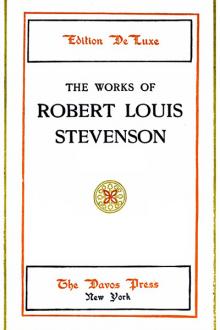
The Works of Robert Louis Stevenson - Swanston Edition Vol. 3
Familiar studies of men and books -- The body-snatcher.
 Free Download
I. Victor Hugo’s Romances II. Some Aspects of Robert Burns III. Walt Whitman IV. Henry David Thoreau: His Character and Opinions V. Yoshida-Torajiro VI. François Villon, Student, Poet, and Housebreaker VII. Charles of Orleans VIII. Samuel Pepys IX. John Knox and His Relations To Women
Book Excerpt
ration, some of the truth is sacrificed; and the result is cold, constrained, and grudging. In short, I might almost everywhere have spoken more strongly than I did.
THOREAU. Here is an admirable instance of the "point of view" forced throughout, and of too earnest reflection on imperfect facts. Upon me this pure, narrow, sunnily-ascetic Thoreau had exercised a great charm. I have scarce written ten sentences since I was introduced to him, but his influence might be somewhere detected by a close observer. Still it was as a writer that I had made his acquaintance; I took him on his own explicit terms; and when I learned details of his life, they were, by the nature of the case and my own parti pris, read even with a certain violence in terms of his writings. There could scarce be a perversion more justifiable than that; yet it was still a perversion. The study, indeed, raised so much ire in the breast of Dr. Japp (H. A. Page), Thoreau's sincere and learned disciple, that had either of us been m
FREE EBOOKS AND DEALS
(view all)











Popular books in Fiction and Literature, Horror, Essays








More books by Robert Louis Stevenson
(view all)




Readers reviews
0.0
LoginSign up
Be the first to review this book