Crime and Punishment
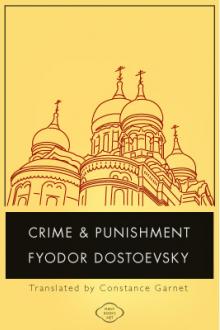
Crime and Punishment
 Free Download
From the Russian master of psychological characterizations, this novel portrays the carefully planned murder of a miserly, aged pawnbroker by a destitute Saint Petersburg student named Raskolnikov, followed by the emotional, mental, and physical effects of that action. Translated by Constance Garnett.
Book Excerpt
u two roubles last time for your ring and one could buy it quite new at a jeweler's for a rouble and a half."
"Give me four roubles for it, I shall redeem it, it was my father's. I shall be getting some money soon."
"A rouble and a half, and interest in advance, if you like!"
"A rouble and a half!" cried the young man.
"Please yourself"--and the old woman handed him back the watch. The young man took it, and was so angry that he was on the point of going away; but checked himself at once, remembering that there was nowhere else he could go, and that he had had another object also in coming.
"Hand it over," he said roughly.
The old woman fumbled in her pocket for her keys, and disappeared behind the curtain into the other room. The young man, left standing alone in the middle of the room, listened inquisitively, thinking. He could hear her unlocking the chest of drawers.
"It must be the top drawer," he reflected. "So she carries the keys in a pocket on the right
FREE EBOOKS AND DEALS
(view all)





Popular books in Fiction and Literature, Harvard Classics, Mystery/Detective


More books by Fyodor Dostoyevsky
(view all)

Readers reviews
4.0
LoginSign up

highly sophisticated plot by actual characters, actually and besides of being one of the greatest novels, it's a reference in psychiatry.
- Upvote (2)
- Downvote (0)

I managed to listen and read this book. This is not very suitable book for practicing of English.
The plot is not so exciting. There is a lot of psychology and little action for me.
The plot is not so exciting. There is a lot of psychology and little action for me.
04/13/2020
Él libró bajo en ingles
11/23/2018
Delirium I tell you.
07/23/2017
I found this book to be much easier to read than most classics. The personalities and culture took a little getting used to, but became endearing after a while. The language was sometimes confusing, but not unbearably so. I do think this book is worth reading.
04/21/2013
Incredible book!
I just couldn't put this down before it was finished. Dostoevsky really makes you think about what Raskolnikov(Main character) is thinking and get inside his mind. One would just despise Raskolnikov when heard of what he had done and his reason, but when we are able to feel and interpret his thoughts through Dostoevsky we are able sympathize with it.
Right as I finished the book I jumped to Brother's Karamazov, which I am still reading.
I just couldn't put this down before it was finished. Dostoevsky really makes you think about what Raskolnikov(Main character) is thinking and get inside his mind. One would just despise Raskolnikov when heard of what he had done and his reason, but when we are able to feel and interpret his thoughts through Dostoevsky we are able sympathize with it.
Right as I finished the book I jumped to Brother's Karamazov, which I am still reading.
07/26/2012
Well Done Dostoyevsky!
02/28/2012
I wanted to kill myself after trying to read this. All I could think to myself was get up and go kill him get it over with.
Dostoyevsky got paid by the word.
Dostoyevsky got paid by the word.
02/21/2012
This is the pinnacle of Dostoevsky's genius. It is imbued with philosophy that speaks of Universal Truth. A must read for those who are in pursuit of answers to some essential questions about life and its essence.
01/20/2011
This book is, IMHO, the best of all Dostoevsky's novels. Furthermore I can say that this is the best one I've ever read, though I am not an indeed advanced reader. Its plot is good and, despite the book is somewhat big, it is read in several days from start to end.
11/28/2010