Nightmare Abbey
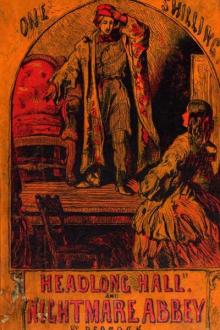
Nightmare Abbey
 Free Download
Book Excerpt
Hilary,--hand Mrs Hilary to the
piano, take charge of her fan and gloves, and turn over her music with
surprising dexterity,--quote Revelations with Mr Toobad,--and lament
the good old times of feudal darkness with the transcendental Mr
Flosky.
CHAPTER II
Shortly after the disastrous termination of Scythrop's passion for Miss Emily Girouette, Mr Glowry found himself, much against his will, involved in a lawsuit, which compelled him to dance attendance on the High Court of Chancery. Scythrop was left alone at Nightmare Abbey. He was a burnt child, and dreaded the fire of female eyes. He wandered about the ample pile, or along the garden-terrace, with 'his cogitative faculties immersed in cogibundity of cogitation.' The terrace terminated at the south-western tower, which, as we have said, was ruinous and full of owls. Here would Scythrop take his evening seat, on a fallen fragment of mossy stone, with his back resting aga
FREE EBOOKS AND DEALS
(view all)


Popular books in Gothic, Satire, Romance, Humor, Fiction and Literature
More books by Thomas Love Peacock
(view all)
Readers reviews
3.7
LoginSign up

(1818) Satire(Romantic movement) / Humor / Gothic
R: * * * *
Plot bullets
Mr Glowry is a misanthrope. He dislikes humanity in general. He is the melancholy owner of Nightmare Abby, as it is called.
He surrounds himself with equally gloomy people. With servants like Raven, Graves and Deathshead, and guest like Mr Flosky, Mr Toobad, Mr Listless, and Mr Cypress. The old gentleman has only one hope for happiness, his son. But, that happiness can only be achieve if he can bring him down to his level of glum.
Scythrop is Glowry's son. He is currently recovering from a failed romance. One his father did not allow, due to an economical mismatch. Scythrop, develops, through his readings of the modern thought of the day, like transcendental metaphysics and such, a plan to correct the worlds woes.
Scythrop's world changing ideas are temporarily on hold due to what appears as a disinterested world, and two ladies, Marionetta and Stella,. He is in love. His efforts fail on all fronts.
There are no true ghosts to haunt the mansion, only the common place spirits of man trying to make sense of things at 'Nightmare Abbey'.
R: * * * *
Plot bullets
Mr Glowry is a misanthrope. He dislikes humanity in general. He is the melancholy owner of Nightmare Abby, as it is called.
He surrounds himself with equally gloomy people. With servants like Raven, Graves and Deathshead, and guest like Mr Flosky, Mr Toobad, Mr Listless, and Mr Cypress. The old gentleman has only one hope for happiness, his son. But, that happiness can only be achieve if he can bring him down to his level of glum.
Scythrop is Glowry's son. He is currently recovering from a failed romance. One his father did not allow, due to an economical mismatch. Scythrop, develops, through his readings of the modern thought of the day, like transcendental metaphysics and such, a plan to correct the worlds woes.
Scythrop's world changing ideas are temporarily on hold due to what appears as a disinterested world, and two ladies, Marionetta and Stella,. He is in love. His efforts fail on all fronts.
There are no true ghosts to haunt the mansion, only the common place spirits of man trying to make sense of things at 'Nightmare Abbey'.
- Upvote (0)
- Downvote (0)
This is a sharp satire, in the style of the Gothic novel, which pokes fun at many of the pretensions of the various strata of society. Centred on Nightmare Abbey, the home of the miserable Mr Glowry and his son, Scythrop, the basic story - of a young man who finds himself involved in a love triangle - has elements of farce.
It’s not the easiest book to read, having long stretches of dialogue and musings, but the apt names of the characters do make it easier to follow, and it’s a witty and entertaining read.
It’s not the easiest book to read, having long stretches of dialogue and musings, but the apt names of the characters do make it easier to follow, and it’s a witty and entertaining read.
08/22/2011
Thomas Love Peacock (1785 - 1866) was a brilliant satirist and author and Nightmare Abbey is a wonderful example of his work.
Part Swift, part Bunyan, the inhabitants of Nightmare Abbey are foils for Peacock's observations on the zeigeist and fads of his day with a wit so sharp you can shave with it.
I never knew a work from 1818 (though I suspect the version here is the revised one from 1837) could actually make me laugh.
Part Swift, part Bunyan, the inhabitants of Nightmare Abbey are foils for Peacock's observations on the zeigeist and fads of his day with a wit so sharp you can shave with it.
I never knew a work from 1818 (though I suspect the version here is the revised one from 1837) could actually make me laugh.
04/03/2008